
When you are living inside an architecture career, it rarely feels like a journey with a clear direction.
It feels like a continuous rush from / constant juggling between deadlines, revisions, meetings, drawings, reports, decisions made quickly then reconsidered slowly. Uncertainty about whether the concept is right, navigating personalities you don’t fully understand, office politics that have nothing to do with design. Sometimes it’s rinsing and repeating the same ideas because you’re overthinking, overdoing, unable to let go.
You move forward because forward is the only direction available. You rarely stop to ask where it is all leading, because pausing too long risks falling behind.
Only later do you realize that what seemed fragmented was forming a narrative, that you were writing it without knowing the ending.
My Undergraduate thesis on Mumbai’s Derelict textile mills traced how history, land economics, social equity, and policy frameworks intersected on a single site.
Recognition for that work mattered less than what it confirmed: that design grounded in research and systems thinking could carry weight beyond the studio. At the time, I did not consider this a “career strategy”, I was simply following curiosity.
Graduate school in Canada introduced a different kind of challenge, not only about learning new methods, but about learning new ways of thinking.
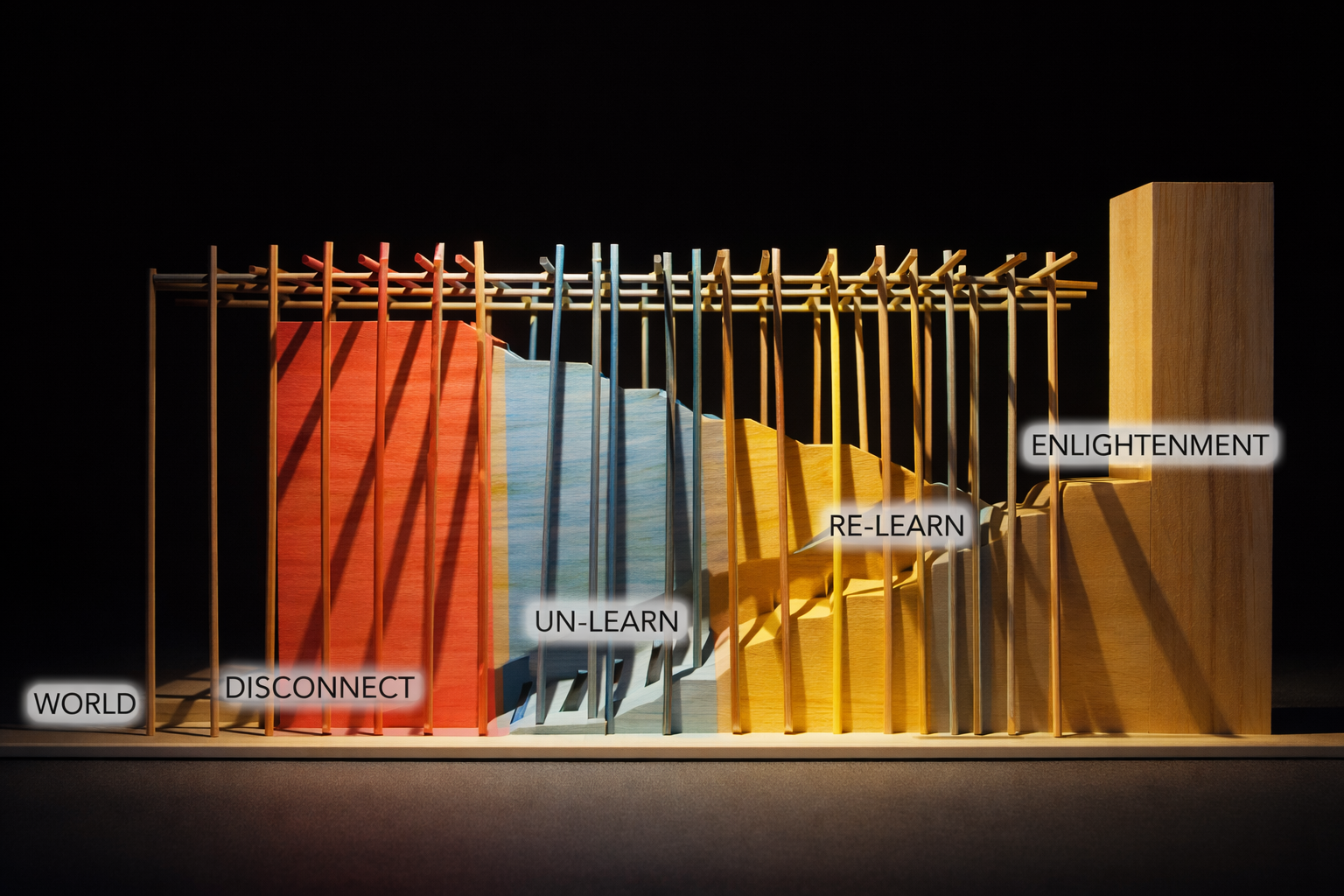
One studio project with my professor Dr. Brian Sinclair became a personal metaphor: Disconnect. Unlearn. Relearn. Enlightenment.
The project demanded that I step away from familiar instincts, dismantle assumptions, and rebuild my approach from the ground up. It required letting go of control—not temporarily, but fundamentally.
I have succeeded at this many times since. I have also failed at it repeatedly. None of these failures appear on résumés. All of them matter. Each one forced recalibration. Each setback sharpened judgment. That cycle never truly ends. It becomes part of how you think.
When I first arrived in Canada, I did not know if I would succeed as an architect here. I did not know how long it would take to find work. I did not know if this profession would sustain me in this new country.
I remember thinking, quite practically, that if it did not work out, I would drive a bus or a truck. At least that would let me survive. At least I could try architecture again later, or maybe not at all.
There was fear in that thought, real fear. But also a kind of resolve. If architecture was not immediately possible, I would find another way to stay. I would not give up the ground I had gained by coming here.
What I did not fully recognize then was that I was already making a choice—to stay in motion even when the direction was unclear. To keep myself in proximity to the work, even if I could not do it right away. To believe that the chapter I was in, however uncertain, belonged to a longer arc I could not yet see.
That belief never left. It resurfaced when I questioned whether I was progressing “fast enough.” When I wondered what success even meant. When the work felt like it was leading nowhere in particular.
Each time, I returned to the same instinct: Follow the story. Do the work. Let meaning emerge later.
Professional practice taught me that architecture happens in layers I had not fully understood in school.
A Toronto project I worked on initially began as a high-rise tower proposal along a major corridor. Early studies supported the height and density. Then the city’s urban design team reviewed the context: the adjacent low-rise neighborhoods, the street wall precedents, the planned character of the district. The feedback was clear. The proposal needed to shift.
We revised down to a midrise,multiple times. Each iteration tested different ways to maintain density while respecting the established scale. The final outcome was more contextual, more defensible, more realistic. It emerged through negotiation and iteration, not individual authorship.
What I learned was not just about compromise. It was about seeing that a project is shaped by forces beyond the architect’s intention—policy frameworks, municipal priorities, community expectations, market realities. These are not obstacles, they are the actual structure within which architecture happens.
This drew me toward the front-end of projects: feasibility studies, zoning analysis, approvals coordination, concept development, this is where policy becomes form. Where regulations become massing. Where economics and urban design intersect. One misinterpreted clause can derail months of work. One missed policy nuance can weaken an entire proposal.
I responded by becoming meticulous. Checklists. Cross-references. Precedents. Documentation. Over time, uncertainty gave way to fluency—not because the system became simpler, but because I became more attentive to how all the parts connected.
Today, when I analyze a complex urban site, I see layers rather than limits, Policy history, Infrastructure logic, Market behavior, Environmental responsibility, Community narratives and Political realities. Every constraint tells a story. Every regulation reveals a priority. Every approval process exposes what a city values.
That perspective was assembled slowly—across projects, across disciplines, across moments when I could not see where any of it was leading.
I am in the middle of my career. I still question my focus. I still hold too tightly when I should let go. I still overthink what should be simpler.
But I keep working. I keep following what pulls me forward. Not because the path is clear, but because it is honest.
This is how I have chosen to practice. By trusting the story while still writing it.
